AnaGain and AnaGain Nu are two different products from the same Swiss supplier, Mibelle Biochemistry, both made from germinated organic pea shoots (Pisum sativum). AnaGain is supplied for topical cosmetic formulation. AnaGain Nu is supplied as a water-soluble powder intended for oral use in supplements and functional foods.
They are not interchangeable, and the research behind them is not identical either. If you are comparing products or reading an ingredients list, this is the distinction that matters most.
Are AnaGain and AnaGain Nu the same ingredient?
Same botanical source, different specification.
Both are extracts of germinated pea shoots. Both were developed by Mibelle Biochemistry in Switzerland using the same bioassay-guided approach. Where they differ is the format the raw material is supplied in, and therefore what a formulator can do with it.
AnaGain Nu is described by Mibelle as a water-soluble powder extract with a neutral taste and odour, suitable for dietary supplement and functional food applications including capsules, shots, drinks, gummies and powder mixes. That water solubility and neutral taste profile is what makes it viable in something you swallow.
AnaGain is the version formulated for topical application in cosmetic products such as serums, tonics and scalp treatments.
So when a serum lists "AnaGain" and a capsule lists "AnaGain Nu", they are not making a typo or using two names for one thing. They are using two different raw materials.
Why the naming confuses almost everyone
Three reasons.
First, the trademark symbol travels with both, so you see AnaGain™ and AnaGain™ Nu written in ways that look like the same product with a suffix.
Second, plenty of brands write "AnaGain" on the label as shorthand regardless of which grade they are actually using. That is common practice, not necessarily an error, but it means the label alone does not always tell you what is in the bottle.
Third, and most significantly, the two share a body of research and the findings get quoted interchangeably. They should not be.
The research: which study belongs to which product
This is where the distinction has practical consequences.
The gene expression work
Mibelle conducted a bioassay study using DNA microarray technology. Gene expression was analysed on plucked hair bulbs following a two week treatment with 2% AnaGain Nu. The results showed an upregulation of Noggin by 85% and FGF-7 by 56%.
Noggin is a protein involved in shortening the telogen, or resting, phase of the hair cycle. FGF-7 is fibroblast growth factor-7, which is involved in the proliferation of matrix keratinocytes at the start of a new anagen, or growth, phase. Both are signalling molecules produced by dermal papilla cells.
We have written about this mechanism in more detail in our full guide to AnaGain and the research behind it.
The oral clinical study
Separately, Mibelle ran an open application trial over 56 days. The study population was 21 healthy adults of mixed genders, mean age 43.9 years, all experiencing mild to moderate hair loss defined as 100 or more hairs lost daily. The mean at baseline was 163.7 hairs.
Participants took 100mg of AnaGain Nu daily, in a drink of their choice. Lost hair counts, scalp photographs and questionnaire responses were assessed at day 0, day 28 and day 56.
Mibelle reports a statistically significant reduction in hair loss counts of 34% after one month and 37% after two months, alongside visibly improved hair density. In the questionnaire, 86% of volunteers reported noticing a reduction in hair loss and 76% said they would like to continue.
The study results were published in Phytotherapy Research, 2020, volume 34, issue 2, pages 428 to 431.
What this means when you read a claim
If a brand cites the 56 day results, they are citing an oral study using 100mg of AnaGain Nu daily.
If a brand cites the Noggin and FGF-7 percentages, they are citing a two week gene expression study using a 2% preparation.
How to read the study honestly
The clinical trial was an open application trial with 21 participants. It was not placebo-controlled and it was not blinded. That is not a reason to dismiss it, and the statistical significance reported is genuine, but it is a small early-stage study and anyone presenting it as definitive proof is overreaching.
We take the view that stating this plainly is more useful than pretending otherwise. The same principle runs through our review of what the evidence on hair supplements for women actually says.
Which one is in Anavive
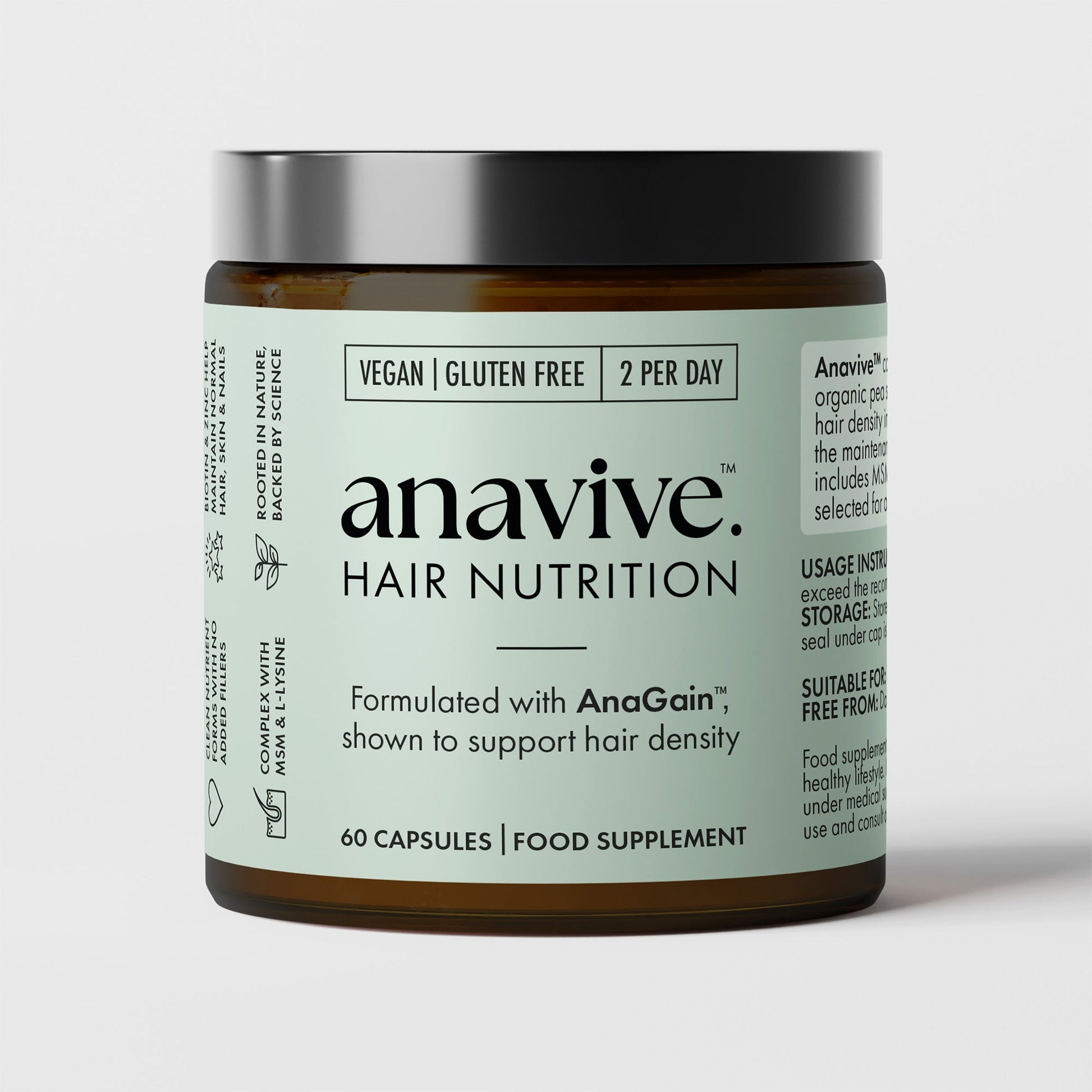
Anavive uses AnaGain Nu, the oral grade, at 100mg per daily serving. That is the same material and the same dose used in the published 56 day trial.
We mention this because it is not something you can assume from a label. A supplement can list AnaGain without specifying the grade or the amount, and at that point you cannot tell whether it corresponds to anything that has been studied orally. Ours does, so we would rather say so precisely than leave you to guess.
You can see the full ingredient breakdown on the Anavive product page.
Alongside the pea shoot extract, the formula includes zinc bisglycinate and biotin, both of which contribute to the maintenance of normal hair, and iron as ferrous bisglycinate, which contributes to normal oxygen transport, paired with vitamin C, which increases iron absorption.
Common questions
Is AnaGain Nu better than AnaGain?
Neither is better. They are formulated for different delivery routes. Mibelle states that efficacy has been demonstrated for both oral and topical applications. No published head to head comparison exists, so any claim that one outperforms the other is not supported by the available research.
Can I take AnaGain Nu and use an AnaGain serum at the same time?
There is no published research on combining them, so there is no evidence either way on whether the effect would be additive. If you are on prescribed medication or being treated for a scalp or hair condition, speak to your pharmacist or GP first.
Is AnaGain a drug?
No. It is a plant extract used as a cosmetic ingredient and as a food supplement ingredient. Food supplements are not medicines and are not intended to treat, prevent or cure any condition.
What dose was used in the research?
100mg of AnaGain Nu daily in the oral trial. The topical bioassay used a 2% preparation over two weeks.
Where to read next
- AnaGain for hair growth: what it is, how it works and what the research actually shows
- What is actually in pea sprouts: a complete nutritional guide
- Spermidine, pea shoots and the science behind plant-based hair research
Anavive is a food supplement and is not a treatment for any medical condition. If you are experiencing sudden or significant hair loss, speak to your GP.
AnaGain is a trademark of Mibelle AG Biochemistry.