Spermidine is not a word that rolls easily off the tongue. It sounds clinical, vaguely industrial, and - if you know its etymology - slightly awkward at a dinner party. But behind the name is a genuinely interesting molecule with a growing body of research behind it, including a real and well-documented role in hair follicle biology.
This post covers what spermidine is, why it matters for hair, where pea shoots fit into the picture, and how a clinically studied pea shoot extract called AnaGain™ works at a biological level to support the maintenance of normal hair.
What spermidine is and where it comes from
Spermidine belongs to a class of molecules called polyamines - naturally occurring compounds derived from amino acids that are found in virtually every living cell. The three main polyamines in human physiology are putrescine, spermidine, and spermine. Despite their unflattering names, these are not fringe biochemicals. They are fundamental to cell growth, proliferation, and survival.
Your body synthesises spermidine on its own, but dietary intake also contributes to the pool. Spermidine is found in a wide range of foods. Research published in Frontiers in Nutrition found that peas, mushrooms, wheat germ, and legumes are among the richest plant-based sources of spermidine, with peas consistently standing out for their high spermidine content relative to other vegetables. A 2021 analysis of polyamine content across 109 food products measured peas at a mean spermidine concentration of 54.4 mg/kg, making them one of the most spermidine-dense vegetables by weight.
There is also a relevant biological detail worth noting: polyamine synthesis in the body tends to decline with age. The implication is that dietary sources become increasingly important as endogenous production falls.
Why the hair follicle depends on polyamines
Hair follicles are not passive structures. They are among the most metabolically active and rapidly proliferating tissues in the human body. That level of cellular turnover requires a constant and substantial supply of polyamines.
This was described clearly in a 2010 paper titled "Polyamines and hair: a couple in search of perfection," which noted that given the hair follicle's status as one of the most highly proliferative organs in mammalian biology, it is unsurprising that polyamines are crucial to follicle growth. A landmark study published in PLOS ONE in 2011 went further. Researchers applied spermidine at varying concentrations to human scalp hair follicles in serum-free organ culture. The results showed that spermidine promoted hair shaft elongation and prolonged the anagen (active growth) phase. It also upregulated expression of epithelial stem cell-associated keratins K15 and K19 - molecules associated with follicle stem cell activity. Separate research found that inhibiting polyamine synthesis in follicles significantly reduced hair fibre growth, and that adding spermidine back to the culture medium partially reversed the effect.
In human terms, a randomised, double-blind, placebo-controlled clinical trial published in 2017 involving 100 healthy subjects found that a spermidine-based nutritional supplement taken daily for 90 days was associated with a prolonged anagen phase compared to placebo. The authors noted this was a preliminary study and that further research is needed, but the directional finding is consistent with the in vitro and animal data that preceded it.
The picture that emerges is fairly coherent: polyamines, and spermidine in particular, appear to play a meaningful role in supporting the biological environment in which hair follicles remain active and growing. When polyamine availability falls - whether through age-related decline in synthesis or inadequate dietary intake - follicle function may be affected.
Pea shoots and why germination matters
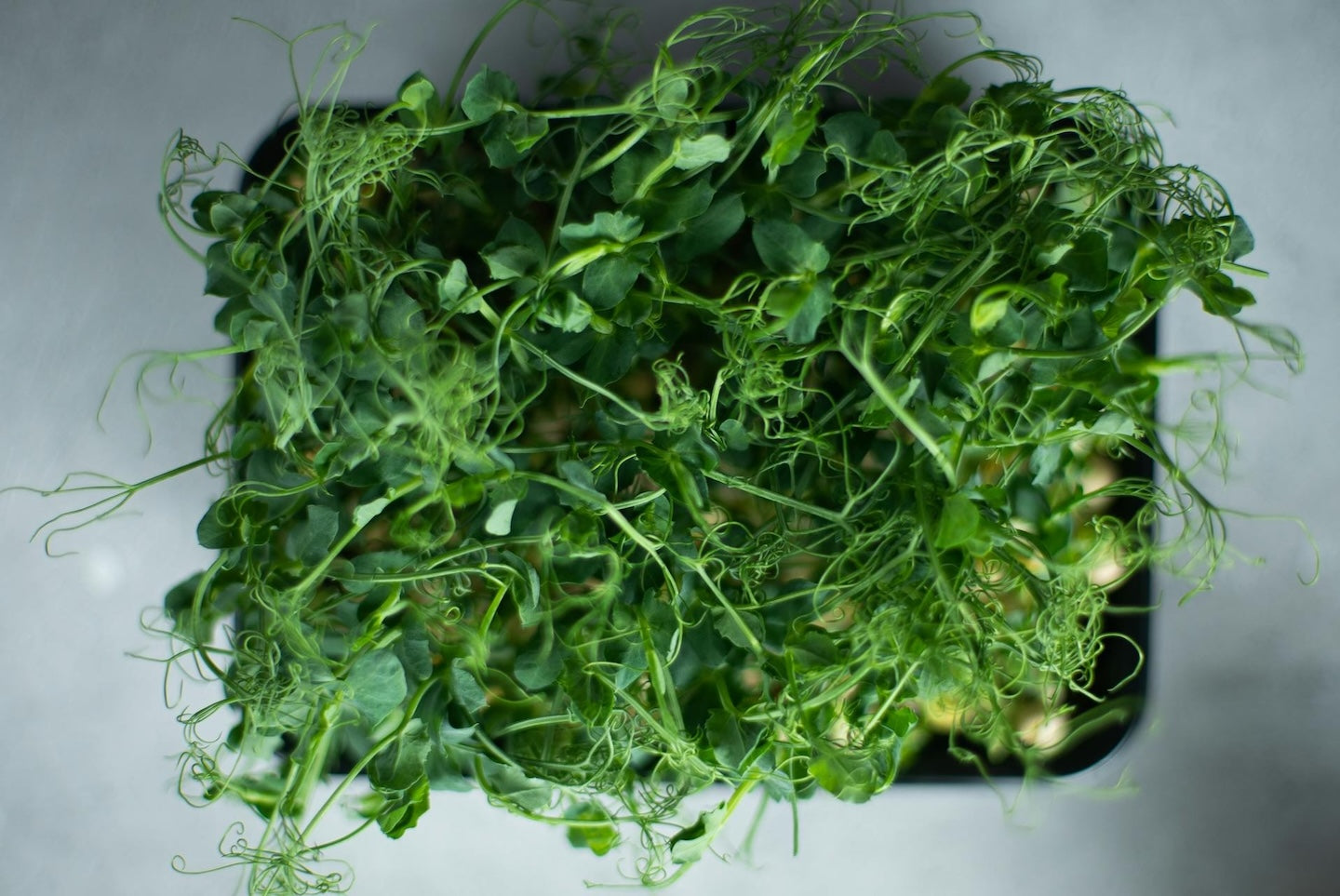
Peas (Pisum sativum) are a well-established source of spermidine. But the more interesting version of the story involves what happens to peas when they germinate.
Germinated plants - sprouts and shoots - are in a uniquely vulnerable state. Because they are not yet lignified, they cannot rely on the structural defences of mature plants. To compensate, they concentrate secondary plant metabolites at much higher levels than their adult counterparts. These metabolites serve a protective function, shielding the young plant from pathogens, UV damage, herbivores, and environmental stress. They also happen to include compounds with real biological activity in human tissue.
Pea shoots also contain notable quantities of adenosine, biotin, and B-complex vitamins alongside their polyamine content - a nutritional profile that reflects the concentrated activity of a plant in its earliest growth stage.
This is not incidental. It is the biological basis on which AnaGain™ was built.
AnaGain™: what the clinical evidence shows
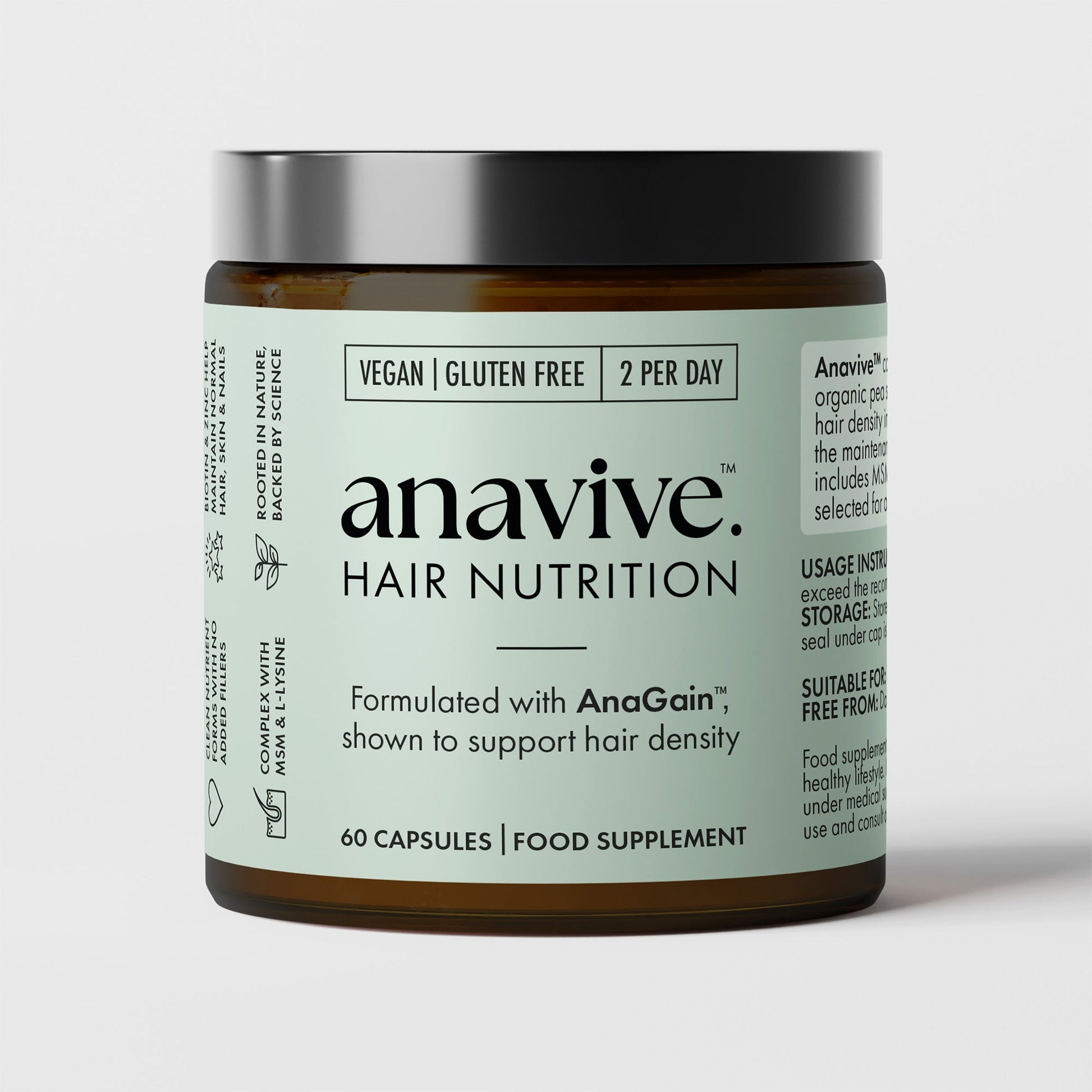
AnaGain™ is a standardised extract prepared from organically germinated peas (Pisum sativum), developed by Mibelle Biochemistry in Switzerland. It was not created by blending existing ingredients. It was developed using a bioassay-guided approach - meaning researchers identified the biological pathways they wanted to influence, then screened pea shoot compounds to find those with measurable effects on those specific pathways.
The pathways in question are centred on the dermal papilla - the cluster of specialised cells at the base of each follicle that effectively controls the hair growth cycle. Dermal papilla cells determine when a follicle enters and exits the anagen (growth) phase. AnaGain™ was found to stimulate two key signalling molecules within these cells:
- FGF7 (fibroblast growth factor 7) - a protein that promotes the proliferation of hair matrix keratinocytes at the start of a new growth phase
- Noggin - a protein that shortens the telogen (resting) phase, helping follicles return to active growth more quickly
In the bioassay study, a two-week treatment with AnaGain™ upregulated Noggin expression by 85% and FGF7 expression by 56% in plucked hair bulbs. These are not trivial numbers. Both signals point in the same direction: more follicles active, resting phases shortened, the ratio of growing to resting hairs shifted in favour of growth.
The clinical findings followed a similar trajectory. In a study of 21 volunteers experiencing mild to moderate hair loss, taking 100mg of AnaGain™ daily for two months produced a statistically significant reduction in hair loss counts of 34% after one month and 37% after two months (p<0.0002 vs baseline at one month; p=0.0002 vs baseline at two months). Participants also reported visibly improved hair density and wished to continue use after the study period ended. These results were published in the peer-reviewed journal Phytotherapy Research (Phytother Res. 2020 Feb;34(2):428-431).
It is worth being clear about what this study demonstrates and what it does not. It involved a relatively small panel of volunteers. It used a food-and-drink delivery method rather than a capsule. The results are directionally consistent with the mechanistic data, and the peer-reviewed publication adds weight. But this is not a phase III drug trial. What it is, however, is more clinical rigour than most hair supplement ingredients carry.
The connection that matters
Peas are a genuinely well-documented dietary source of spermidine. Spermidine has been shown, in peer-reviewed research, to support hair shaft elongation and prolong the anagen phase in human follicle cultures. Germinated pea shoots concentrate the bioactive compounds of the parent plant at higher levels than mature peas. AnaGain™ is a standardised extract of those shoots, developed specifically for its measurable effects on dermal papilla cell signalling.
The story is not "peas are magic" - it is more specific than that. It is that the biology of the pea plant, particularly at its earliest growth stage, contains compounds that appear to interact meaningfully with the biological machinery responsible for keeping hair follicles in their active phase.
Hair thinning rarely has a single cause. Hormonal shifts, nutrient gaps, chronic stress, and the natural shortening of anagen phases with age all play a role. Supporting the follicle environment from multiple directions - rather than chasing a single mechanism - is the approach that makes most sense from a physiological standpoint. AnaGain™ addresses one part of that picture with unusual precision.
It is worth being clear about one thing: AnaGain™ was not developed as a spermidine delivery ingredient. Mibelle's research identified its mechanism of action through FGF7 and Noggin stimulation in dermal papilla cells - not through polyamine pathways specifically. What we can say is that peas are one of the most spermidine-rich vegetables in the food supply, and that AnaGain™ is derived from those same plants at their most biologically concentrated stage. The spermidine research and the AnaGain™ research are therefore parallel lines of evidence pointing in the same direction - both rooted in pea plant biology, both showing meaningful effects on hair follicle activity, but through mechanisms that have been studied independently rather than as a single chain.
How AnaGain™ fits within Anavive
Anavive was formulated around AnaGain™ as its lead active, at the clinically studied dose of 100mg per serving. The broader formulation is designed to support the same underlying biology from complementary angles: zinc and biotin, which contribute to the maintenance of normal hair; iron and vitamin C, which support normal oxygen transport and enhance iron absorption; and vitamin B6, which contributes to normal hormonal activity. Zinc bisglycinate, iron bisglycinate, and vitamin B6 in its active P-5-P form are chosen for their superior bioavailability relative to cheaper alternatives.
The result is a supplement designed not around a single trend ingredient, but around a system of support for the conditions in which hair follicles function normally.
If you are researching spermidine for hair health, it is worth understanding that the mechanism involves the whole biological context of the follicle - not just one molecule in isolation.