

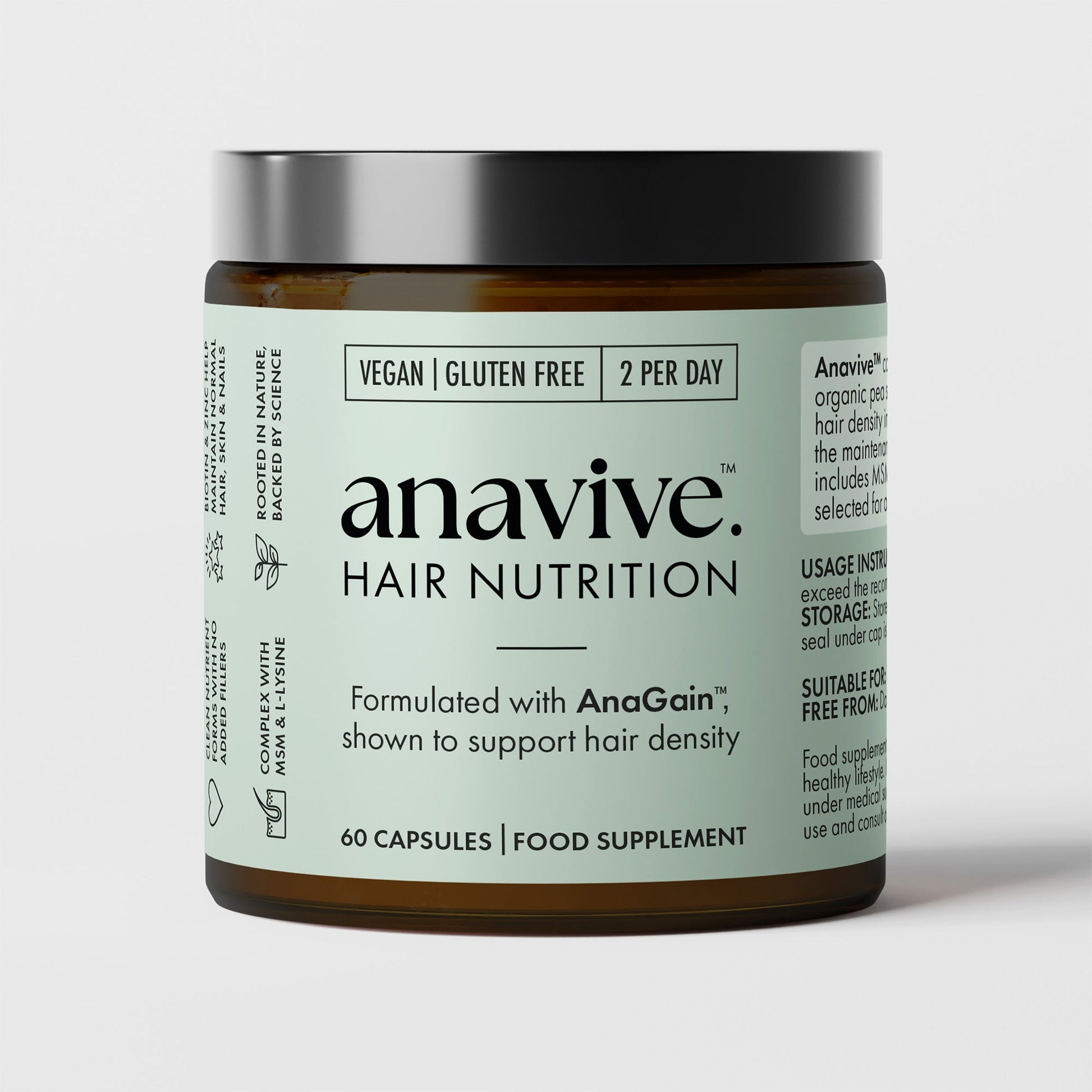




Anavive Hair Nutrition - 1 Month Supply
Anavive Hair Nutrition - 1 Month Supply
Thinning doesn’t just change your hair, it changes how you feel. The extra strands in the shower. The way you adjust your parting. The quiet sense that something is shifting. Hair rarely thins without reason, which is why Anavive is built to support the internal foundations healthy hair depends on.
Not all supplements are created equal - and the difference rarely shows on the label. Most use poorly absorbed ingredient forms that pass through your body largely unused. If the nutrients don't absorb, the formula doesn't work. Even with a decent diet, consistently hitting the right levels of zinc, iron, B vitamins, and botanicals that have been seen to support hair follicle activity isn't something food alone reliably delivers.
Anavive™ is built around a different principle: that the right ingredient forms, in the right combination, give your body something it can actually use.
Anavive is a premium daily hair health supplement formulated for men and women experiencing excessive shedding, thinning or slow regrowth. At its core is AnaGain™ - an extract from organic pea shoots, clinically studied to influence the signals that determine how many follicles are in an active growing phase. Alongside it, zinc bisglycinate and iron bisglycinate - forms chosen for their superior absorption over the oxides and sulphates used in many supplements. Vitamin B6 is delivered as P-5-P, the form your body can use directly, and Vitamin C as Calcium Ascorbate - which also contributes to normal iron absorption. Zinc and biotin contribute to the maintenance of normal hair.
The result is a formula designed to work at the level where most others don't: absorption.
Made in the UK, vegan and allergen-free, Anavive™ helps promote visibly thicker and healthier hair with consistent daily use.
In stock
Couldn't load pickup availability
How to use
How to use
Ingredients
Ingredients
Delivery Info
Delivery Info
You'll receive free delivery if you order 3 or more items in 1 delivery. We ship in unbranded packaging using a UK courier which normally takes 2 days after dispatch (Monday - Friday).
For orders under 3 items, we charge a £3.99 fee to cover delivery costs.
We'll let you know as soon as your order is shipped by email with a link to track your delivery. We'll be in touch in the unlikely event there's a delay.
Returns
Changed your mind? Please contact our Customer Success team via email to discuss your returns. Please note:
Products must be returned in the original packaging and unopened to qualify for a refund.
For full details please see our Terms & Conditions.
Share this product
Hair Timeline
What to expect
Around four weeks in, you may begin to notice less hair in your brush or shower drain as daily shedding starts to feel more balanced.
Reduced Shedding
Day 28With continued daily use, hair can look and feel stronger, fuller and more resilient as your follicles are consistently supported from within.
Fuller, Stronger-Looking Hair
DAY 90+Improved Hair Density
By eight weeks, hair can start to appear thicker and more evenly distributed, with subtle improvements in overall fullness becoming visible.
Reduced Shedding
Around four weeks in, you may begin to notice less hair in your brush or shower drain as daily shedding starts to feel more balanced.
Improved Hair Density
By eight weeks, hair can start to appear thicker and more evenly distributed, with subtle improvements in overall fullness becoming visible.
Fuller, Stronger-Looking Hair
With continued daily use, hair can look and feel stronger, fuller and more resilient as your follicles are consistently supported from within.
Judge us by our results

Sammy
My hair is looking fuller, thicker and so much healthier from the root - the density at my scalp has improved so much

Caren
I’ve been using this product for almost 3 months and I’m taking it religiously everyday. It has made a significant difference in my hair. It’s healthier and I’ve noticed more growth.

Zoe
So so pleased with how noticeable the change has been even after just a couple of months. Thank you!

Alex
Brilliant results so far!! These are great :)
90-Day Satisfaction Guarantee
We're confident in Anavive's quality and formulation.
If you're not satisfied with your results after 90 days of consistent use, contact us and we'll make it right.
Not all vitamins are created equal
The form of an ingredient matters just as much as the ingredient itself.
If your body can't absorb it, your hair can't benefit from it.

Better forms your body can actually use
We use active, bioavailable forms of nutrients so your body absorbs more and wastes less.

Easier on the stomach
Buffered and chelated forms are gentler than standard vitamins, making Anavive more suited for daily use.

Chosen for effectiveness, not cost
Many supplements use cheaper forms to save on costs.
We select premium forms even when they’re harder to source.

More absorption, better results
When your body can use what you take, you’re more likely to see consistent, noticeable improvements over time.
This includes forms like buffered vitamin C, zinc bisglycinate, and active vitamin B6.


Why are customers switching to premium hair nutrition
Discover why customers are switching to Anavive Hair Nutrition from other brands
Inside Anavive
A focused blend of ingredients chosen to support hair from the inside out.
These are some of the key actives inside Anavive.

AnaGain™ (Pea Shoot Extract)
Clinically studied to help reduce hair shedding and support new growth by reactivating hair follicles.

Biotin + Zinc
Support the maintenance of normal hair, skin, and nails - essential for daily hair strength and resilience.

MSM + Bamboo Silica
Provides sulphur and silica, key building blocks used in hair structure.

Iron + Vitamin C
Helps deliver oxygen and nutrients to the scalp for healthy growth.
For the full ingredient list, see our Frequently Asked Questions.
We're here for you!
Formulated and manufactured in the UK by leading hair and wellness specialists, Anavive is built on expertise you can trust.
Any question about our products? Check if you can find them here or get in touch for more info.
How long does it take to see results from Anavive?
How long does it take to see results from Anavive?
The Anavive formula is new, however clinical studies of AnaGain™, the pea shoot extract inside Anavive, have shown results in as little as 28 days.
Results may vary, but every batch of Anavive is made in the UK to ensure premium quality and reliable results.
Is Anavive suitable for both men and women?
Is Anavive suitable for both men and women?
Yes. Anavive is a gender-neutral hair supplement designed for adults who want to support healthy hair growth and scalp vitality.
Where is Anavive made?
Where is Anavive made?
Anavive is proudly formulated and manufactured in the United Kingdom under GMP standards. Our UK-based production ensures traceable ingredients and consistent, high-quality manufacturing.
Can I take Anavive with other supplements?
Can I take Anavive with other supplements?
Anavive is designed to complement most daily wellness routines. However, if you’re already taking other supplements or prescribed medication, or have any medical conditions, we recommend checking the nutrient reference values (NRVs) and speaking with your GP or pharmacist to ensure your total intake stays within safe levels.
Is Anavive vegan and allergen-free?
Is Anavive vegan and allergen-free?
Yes - Anavive capsules are suitable for vegan and gluten-free diets, and made without common allergens.
Anavive Hair Nutrition Blog

AnaGain serum vs AnaGain capsule: what each study actually tested
AnaGain appears in two very different kinds of product: topical serums and scalp tonics on one side, oral capsules and supplement drinks on the other. Both formats have supporting research from Mibelle Biochemistry, the Swiss company that developed the ingredient. Neither has been tested against the other. That last point matters, because it means anyone telling you the serum works better than the capsule, or the other way round, is telling you something the research does not show. Here is what each study actually measured. The short version The topical work was a two week gene expression study. It looked at what happens inside hair follicle cells at a molecular level. It did not measure hair. The oral work was a 56 day trial, counted shed hairs and took scalp photographs. It did not measure gene expression. Two different questions, two different answers, no direct comparison between them. What the topical research measured Mibelle developed AnaGain using a bioassay-guided approach based on DNA microarray technology. In the study most often quoted by serum brands, gene expression was analysed on plucked hair bulbs after two weeks of treatment with a 2% AnaGain Nu preparation. Two signalling molecules were upregulated: Noggin, by 85%. Noggin is involved in shortening the telogen phase, which is the resting portion of the hair cycle. FGF-7, by 56%. FGF-7 is fibroblast growth factor-7, involved in the proliferation of matrix keratinocytes at the beginning of a new anagen phase. Both are produced by dermal papilla cells, the cluster of cells at the base of the follicle that governs cycling. We go into the mechanism properly in our main AnaGain guide. What this study demonstrates is that the extract can influence the signalling environment in follicle cells. What it does not demonstrate is a visible result on a person's head, because that is not what it was designed to measure. Gene expression changes are a plausible mechanism, not an outcome. What the oral research measured The oral study was an open application trial running 56 days. Healthy adults of mixed genders, mean age 43.9 years, all losing 100 or more hairs daily at baseline, with a group mean of 163.7. Each took 100mg of AnaGain Nu daily in a drink. Assessments were taken at day 0, day 28 and day 56, covering lost hair counts, scalp photographs and a questionnaire. Reported was a 34% reduction in hair loss counts at one month and 37% at two months, both statistically significant, along with visibly improved hair density. Of the volunteers, 86% reported noticing a reduction in shedding and 76% wanted to continue. The findings were published in Phytotherapy Research, 2020, volume 34, issue 2, pages 428 to 431. This one measured a visible endpoint. The question serum labels rarely answer Here is the practical problem with buying a topical on the strength of that gene expression data. The study used a 2% preparation. Most serums do not tell you what concentration of AnaGain they contain. AnaGain might sit near the top of the ingredients list or near the bottom, and unless the brand publishes a figure, you have no way of knowing whether you are getting something close to what was studied or a fraction of it. This is not unique to AnaGain or to serums. It is the general condition of the active ingredient market. But it is worth asking before you spend, and any brand confident in its formulation should be able to tell you. The same test applies to capsules. If a supplement lists AnaGain without a milligram figure, you cannot compare it to the 100mg used in the trial. It is also worth checking which grade is declared, since AnaGain and AnaGain Nu are different raw materials and only the Nu grade is specified for oral use. We cover that distinction in our guide to AnaGain vs AnaGain Nu. For transparency on our own product: Anavive contains 100mg of AnaGain Nu per daily serving, matching the grade and dose used in the published oral study. Topical or oral: how to think about it Rather than asking which is better, it helps to ask what each one can and cannot reach. A serum delivers an active to the scalp surface. That is direct access to the area you care about, and no digestive system in the way. What it cannot do is address anything happening elsewhere in the body. An oral supplement is systemic. It cannot target the scalp specifically, but it can carry more than one ingredient at once, which matters because hair is not built from a single input. Follicles need iron for oxygen transport, and vitamin C increases iron absorption. Zinc and biotin contribute to the maintenance of normal hair. Copper contributes to the maintenance of normal hair pigmentation. Vitamin B6 contributes to the regulation of hormonal activity. A serum cannot correct a nutritional shortfall. A capsule cannot sit on your scalp. They are answering different parts of the same problem. If the underlying issue is a nutritional one, no topical will resolve it. If you want to understand where those shortfalls tend to come from, our evidence review on supplements for hair loss in women is the place to start. What about combining them? No published study has tested AnaGain topically and orally at the same time, so nobody can tell you whether the effects add up, overlap or make no difference in combination. Anyone claiming otherwise is guessing. If you are already using a prescribed topical treatment, or being treated for a scalp condition, check with your pharmacist or GP before layering products. Common questions Does AnaGain work better as a serum or a supplement? There is no head to head study, so this cannot be answered from the evidence. Mibelle states that efficacy has been demonstrated for both oral and topical applications, but those were separate studies with different designs and different endpoints. What concentration of AnaGain should a serum contain? The bioassay work used a 2% preparation. Most serums do not publish their concentration. If it is not stated, ask the brand. How much AnaGain is in a capsule? It varies by product. The oral trial used 100mg daily. Check the supplement facts panel for a milligram figure rather than relying on the ingredient appearing in the list. Is AnaGain in shampoo any use? Rinse-off products have very short contact time with the scalp compared to a leave-on serum. No study has assessed AnaGain delivered in a rinse-off format, so there is no evidence to draw on. Where to read next AnaGain for hair growth: what it is, how it works and what the research actually shows Your scalp microbiome: what matters, what is nonsense Red light therapy: does it actually work Anavive is a food supplement and is not a treatment for any medical condition. If you are experiencing sudden or significant hair loss, speak to your GP. AnaGain is a trademark of Mibelle AG Biochemistry.
Learn more
Noggin and FGF-7: the two proteins behind the AnaGain research
Almost every claim made about AnaGain traces back to two numbers: Noggin upregulated by 85%, FGF-7 by 56%. Those figures get quoted constantly and explained almost never. Both are signalling proteins produced by dermal papilla cells at the base of the hair follicle. Both are involved in moving a follicle out of its resting phase and into a new growth phase. Here is what they actually do, and what the measurement does and does not tell you. Where the numbers come from Mibelle Biochemistry developed AnaGain using a bioassay-guided approach based on DNA microarray technology, which is a method for measuring which genes are being expressed and at what level across thousands of genes at once. Gene expression was analysed on plucked hair bulbs following a two week treatment with a 2% AnaGain Nu preparation. The analysis showed Noggin upregulated by 85% and FGF-7 by 56%. Note the design. This measured gene expression in follicle tissue. It did not measure hair on anyone's head. That was a separate study, covered in our main AnaGain guide. First, the dermal papilla At the base of every hair follicle sits a small cluster of specialised cells called the dermal papilla. It is not part of the hair itself. It sits underneath, connected to the blood supply, and it functions as the control centre for that follicle. The dermal papilla decides when a follicle cycles. It receives signals from the body and sends chemical instructions to the surrounding cells that build the hair shaft. Change what the dermal papilla is signalling and you change how that follicle behaves. This is why the papilla is the target in most follicle research. It is the switch, not the output. The hair cycle in one paragraph Anagen is the active growth phase, lasting anywhere from two to seven years on the scalp. Catagen is a brief transitional phase of a couple of weeks. Telogen is the resting phase, roughly three months, at the end of which the old hair sheds and a new one begins forming in the same follicle. Every follicle runs this cycle independently. At any moment, most of your scalp follicles are in anagen and a minority are in telogen. Thinning tends to show up when that proportion shifts, when follicles spend longer resting and less time growing. What Noggin does Noggin is an antagonist. Its job is to block another signalling protein, BMP, which acts as a brake on follicle activity. High BMP signalling keeps a follicle sitting in telogen. Noggin releases that brake. Practically, Noggin is associated with shortening the telogen phase. A follicle that spends less time resting spends proportionally more time growing. That is the significance of the 85% figure. It concerns the exit from rest, not the growth itself. What FGF-7 does FGF-7, fibroblast growth factor-7, also called keratinocyte growth factor, handles the other half. Once a follicle begins a new anagen phase, it needs to build a hair. That is done by matrix keratinocytes, rapidly dividing cells that produce the keratin making up the hair shaft. FGF-7 promotes the proliferation of those cells at the start of a new anagen phase. The 56% figure concerns construction capacity. Noggin gets the follicle out of rest; FGF-7 supports the building work that follows. Why both together Neither is much use alone. Exiting telogen without the matrix cells to build a hair produces a follicle in the growth phase with nothing to show for it. Building capacity in a follicle still stuck resting produces nothing at all. Mibelle describes the combination as balancing the hair growth cycle, which is a more accurate framing than most of what gets written about it. The mechanism is about the ratio of growing to resting follicles, not about making individual hairs grow faster or thicker. What upregulation does not mean This is the part worth reading twice. Gene expression measurement tells you the level of a signal. It does not tell you the outcome. An 85% increase in Noggin expression is a change in the biological conversation happening at the follicle. It is not a percentage of anything you would see. The figures also came from a two week study on plucked hair bulbs using a 2% topical preparation. They cannot be transferred to a capsule at a different dose, and they were never intended to be read as a consumer-facing result. Where you see the two numbers deployed to imply an outcome, the implication is being added by the marketing rather than the research. The genuine value of the bioassay is that it identifies a plausible mechanism, which is what justified running a human trial. It is the beginning of an evidence chain rather than the end of one. Signalling is not the only input A follicle can be receiving the right instructions and still lack the raw materials to act on them. Hair is largely keratin, a protein high in sulphur-containing amino acids. Building it requires amino acids, sulphur, and a set of micronutrients acting as cofactors. It requires oxygen delivered to the follicle by the blood. This is where the additional nutrients come in to play. Zinc and biotin contribute to the maintenance of normal hair. Iron contributes to normal oxygen transport, and vitamin C increases iron absorption. Copper contributes to the maintenance of normal hair pigmentation. Vitamin B6 contributes to the regulation of hormonal activity. Instruction and supply are separate problems. A signalling ingredient does not solve a nutritional shortfall, and a nutritional foundation does not by itself alter follicle signalling. That is the reasoning behind how Anavive is put together: 100mg of AnaGain Nu, the oral grade used in the published trial, alongside the nutrients the follicle needs to act on any signal it receives. Common questions What is Noggin? A signalling protein that blocks BMP signalling. In hair biology it is associated with shortening the telogen resting phase of the follicle cycle. What is FGF-7? Fibroblast growth factor-7, also known as keratinocyte growth factor. It promotes the proliferation of matrix keratinocytes, the cells that construct the hair shaft, at the beginning of a new anagen phase. Does an 85% increase in Noggin mean 85% more hair? No. It is a measure of gene expression in follicle tissue, not a measure of hair. The two are not equivalent and cannot be converted into one another. What are dermal papilla cells? A cluster of specialised cells at the base of each hair follicle that regulate when the follicle cycles between growth and rest. They are the target of most follicle signalling research. Are these proteins affected by anything other than supplements? Follicle signalling is influenced by hormones, age, stress, illness and nutritional status among other factors. No single input controls it. Where to read next AnaGain for hair growth: what it is, how it works and what the research actually shows Spermidine, pea shoots and the science behind plant-based hair research What is actually in pea sprouts: a complete nutritional guide Anavive is a food supplement and is not a treatment for any medical condition. If you are experiencing sudden or significant hair loss, speak to your GP. AnaGain is a trademark of Mibelle AG Biochemistry.
Learn more
AnaGain dosage: how much, how long, and what the timeline in the research looked like
The dose used in the published oral study of AnaGain was 100mg daily. The Swiss manufacturer that developed the ingredient, gives 100mg as its recommended daily dosage for supplement applications. The study ran for 56 days, with measurements taken at day 0, day 28 and day 56. The dose: 100mg daily The manufacturer specifies 100mg per day for AnaGain Nu, the water-soluble grade used in supplements and functional foods. That is the figure used in the clinical trial and the figure quoted in the supplier's technical literature. If a product lists AnaGain in its ingredients but does not state a milligram amount, you cannot tell how it compares. An ingredient can appear on a label at any quantity, and its position in the list only tells you relative order, not amount. For topical products, the bioassay work used a 2% preparation over two weeks. Serums rarely publish their concentration. How much is in Anavive Anavive contains 100mg of AnaGain Nu per daily serving of two capsules. Same grade, same dose as the published oral trial. We are specific about this for a reason. A supplement can list AnaGain on its label at any quantity, and without a milligram figure there is no way to compare it to the research. Underdosing a branded ingredient so it can appear on a label is a well-established habit in this category. If a product does not state the amount, it is reasonable to ask why. The full breakdown of every ingredient and its amount is on the Anavive product page. The timeline in the study Twenty-one healthy adults of mixed genders, mean age 43.9 years, all losing 100 or more hairs daily at baseline, with a group mean of 163.7 hairs. Each took 100mg of AnaGain Nu daily in a drink of their choice. Day 0 Baseline hair counts, scalp photographs and questionnaire responses recorded. Day 28 A 34% reduction in lost hair counts against baseline, described as statistically significant. Day 56 A 37% reduction against baseline, alongside visibly improved hair density. In the questionnaire, 86% of volunteers reported noticing a reduction in hair loss and 76% wished to continue. Published in Phytotherapy Research, 2020, volume 34, issue 2, pages 428 to 431. Why hair timelines are slow regardless Whatever you take, the hair cycle sets the pace. Hair grows in three phases. Anagen is the active growth phase and can last several years. Catagen is a short transitional phase. Telogen is the resting phase, at the end of which the hair sheds and a new one begins forming. Each follicle runs on its own schedule, independently of its neighbours. So a change in follicle signalling does not produce a synchronised visible result. It produces a gradual shift as individual follicles reach the point in their own cycle where the change can register. Scalp hair grows at roughly a centimetre a month. Even where new growth begins immediately, it takes months to reach a length where you can see it in a mirror rather than only in a photograph. This is why measured hair counts move before anything looks different, and why photographs taken under consistent lighting are more reliable than your impression in the bathroom. The practical part: consistency beats timing Nothing in the research suggests a particular time of day matters. What does matter is taking it daily without gaps, because the mechanism under study is a sustained signalling change rather than an acute effect. Pick a fixed point in your routine and attach it to something you already do. Anavive is taken as two capsules once a day with a meal. One note on iron: if you take levothyroxine, separate it from any iron-containing supplement by two to three hours, since iron reduces its absorption. Our iron spotlight covers this. Tracking it honestly Take a photograph on day one. Same room, same light source, same time of day, same parting, hair dry. Repeat monthly. Memory is a poor instrument for gradual change in either direction, which is why the study used photographs and counts rather than asking people how they felt about it. Bad days will feel like decline and good hair days will feel like proof. Neither is data. Common questions How much AnaGain should I take per day? The recommended daily dosage is 100mg, which is the amount used in the published oral trial. Follow the dosage on the product you are using. How long before I see anything? The published study measured a change in shed hair counts at 28 days and reported visibly improved density by 56 days. Individual experience will vary, and a measured reduction in shedding is not the same as a visible change in the mirror. Can I take more than 100mg for faster results? There is no research on higher doses, so there is no evidence that more produces more, and no safety data at higher intakes. Follow the label. What happens if I miss a day? Take the next dose as normal. Do not double up. The relevant thing is the pattern over weeks, not any single day. How long should I keep taking it? The study ran 56 days and there is no published data beyond that. Assess at the eight to twelve week mark using photographs rather than impression, and if you are seeing nothing at all by then, that is a reasonable point to reconsider. Where to read next AnaGain for hair growth: what it is, how it works and what the research actually shows What is actually in pea sprouts: a complete nutritional guide Why 2 in 5 young adults are already thinking about hair loss Anavive is a food supplement and is not a treatment for any medical condition. If you are experiencing sudden or significant hair loss, speak to your GP. AnaGain is a trademark of Mibelle AG Biochemistry.
Learn more
AnaGain vs AnaGain Nu: what the difference actually is
AnaGain and AnaGain Nu are two different products from the same Swiss supplier, Mibelle Biochemistry, both made from germinated organic pea shoots (Pisum sativum). AnaGain is supplied for topical cosmetic formulation. AnaGain Nu is supplied as a water-soluble powder intended for oral use in supplements and functional foods. They are not interchangeable, and the research behind them is not identical either. If you are comparing products or reading an ingredients list, this is the distinction that matters most. Are AnaGain and AnaGain Nu the same ingredient? Same botanical source, different specification. Both are extracts of germinated pea shoots. Both were developed by Mibelle Biochemistry in Switzerland using the same bioassay-guided approach. Where they differ is the format the raw material is supplied in, and therefore what a formulator can do with it. AnaGain Nu is described by Mibelle as a water-soluble powder extract with a neutral taste and odour, suitable for dietary supplement and functional food applications including capsules, shots, drinks, gummies and powder mixes. That water solubility and neutral taste profile is what makes it viable in something you swallow. AnaGain is the version formulated for topical application in cosmetic products such as serums, tonics and scalp treatments. So when a serum lists "AnaGain" and a capsule lists "AnaGain Nu", they are not making a typo or using two names for one thing. They are using two different raw materials. Why the naming confuses almost everyone Three reasons. First, the trademark symbol travels with both, so you see AnaGain™ and AnaGain™ Nu written in ways that look like the same product with a suffix. Second, plenty of brands write "AnaGain" on the label as shorthand regardless of which grade they are actually using. That is common practice, not necessarily an error, but it means the label alone does not always tell you what is in the bottle. Third, and most significantly, the two share a body of research and the findings get quoted interchangeably. They should not be. The research: which study belongs to which product This is where the distinction has practical consequences. The gene expression work Mibelle conducted a bioassay study using DNA microarray technology. Gene expression was analysed on plucked hair bulbs following a two week treatment with 2% AnaGain Nu. The results showed an upregulation of Noggin by 85% and FGF-7 by 56%. Noggin is a protein involved in shortening the telogen, or resting, phase of the hair cycle. FGF-7 is fibroblast growth factor-7, which is involved in the proliferation of matrix keratinocytes at the start of a new anagen, or growth, phase. Both are signalling molecules produced by dermal papilla cells. We have written about this mechanism in more detail in our full guide to AnaGain and the research behind it. The oral clinical study Separately, Mibelle ran an open application trial over 56 days. The study population was 21 healthy adults of mixed genders, mean age 43.9 years, all experiencing mild to moderate hair loss defined as 100 or more hairs lost daily. The mean at baseline was 163.7 hairs. Participants took 100mg of AnaGain Nu daily, in a drink of their choice. Lost hair counts, scalp photographs and questionnaire responses were assessed at day 0, day 28 and day 56. Mibelle reports a statistically significant reduction in hair loss counts of 34% after one month and 37% after two months, alongside visibly improved hair density. In the questionnaire, 86% of volunteers reported noticing a reduction in hair loss and 76% said they would like to continue. The study results were published in Phytotherapy Research, 2020, volume 34, issue 2, pages 428 to 431. What this means when you read a claim If a brand cites the 56 day results, they are citing an oral study using 100mg of AnaGain Nu daily. If a brand cites the Noggin and FGF-7 percentages, they are citing a two week gene expression study using a 2% preparation. How to read the study honestly The clinical trial was an open application trial with 21 participants. It was not placebo-controlled and it was not blinded. That is not a reason to dismiss it, and the statistical significance reported is genuine, but it is a small early-stage study and anyone presenting it as definitive proof is overreaching. We take the view that stating this plainly is more useful than pretending otherwise. The same principle runs through our review of what the evidence on hair supplements for women actually says. Which one is in Anavive Anavive uses AnaGain Nu, the oral grade, at 100mg per daily serving. That is the same material and the same dose used in the published 56 day trial. We mention this because it is not something you can assume from a label. A supplement can list AnaGain without specifying the grade or the amount, and at that point you cannot tell whether it corresponds to anything that has been studied orally. Ours does, so we would rather say so precisely than leave you to guess. You can see the full ingredient breakdown on the Anavive product page. Alongside the pea shoot extract, the formula includes zinc bisglycinate and biotin, both of which contribute to the maintenance of normal hair, and iron as ferrous bisglycinate, which contributes to normal oxygen transport, paired with vitamin C, which increases iron absorption. Common questions Is AnaGain Nu better than AnaGain? Neither is better. They are formulated for different delivery routes. Mibelle states that efficacy has been demonstrated for both oral and topical applications. No published head to head comparison exists, so any claim that one outperforms the other is not supported by the available research. Can I take AnaGain Nu and use an AnaGain serum at the same time? There is no published research on combining them, so there is no evidence either way on whether the effect would be additive. If you are on prescribed medication or being treated for a scalp or hair condition, speak to your pharmacist or GP first. Is AnaGain a drug? No. It is a plant extract used as a cosmetic ingredient and as a food supplement ingredient. Food supplements are not medicines and are not intended to treat, prevent or cure any condition. What dose was used in the research? 100mg of AnaGain Nu daily in the oral trial. The topical bioassay used a 2% preparation over two weeks. Where to read next AnaGain for hair growth: what it is, how it works and what the research actually shows What is actually in pea sprouts: a complete nutritional guide Spermidine, pea shoots and the science behind plant-based hair research Anavive is a food supplement and is not a treatment for any medical condition. If you are experiencing sudden or significant hair loss, speak to your GP. AnaGain is a trademark of Mibelle AG Biochemistry.
Learn more